
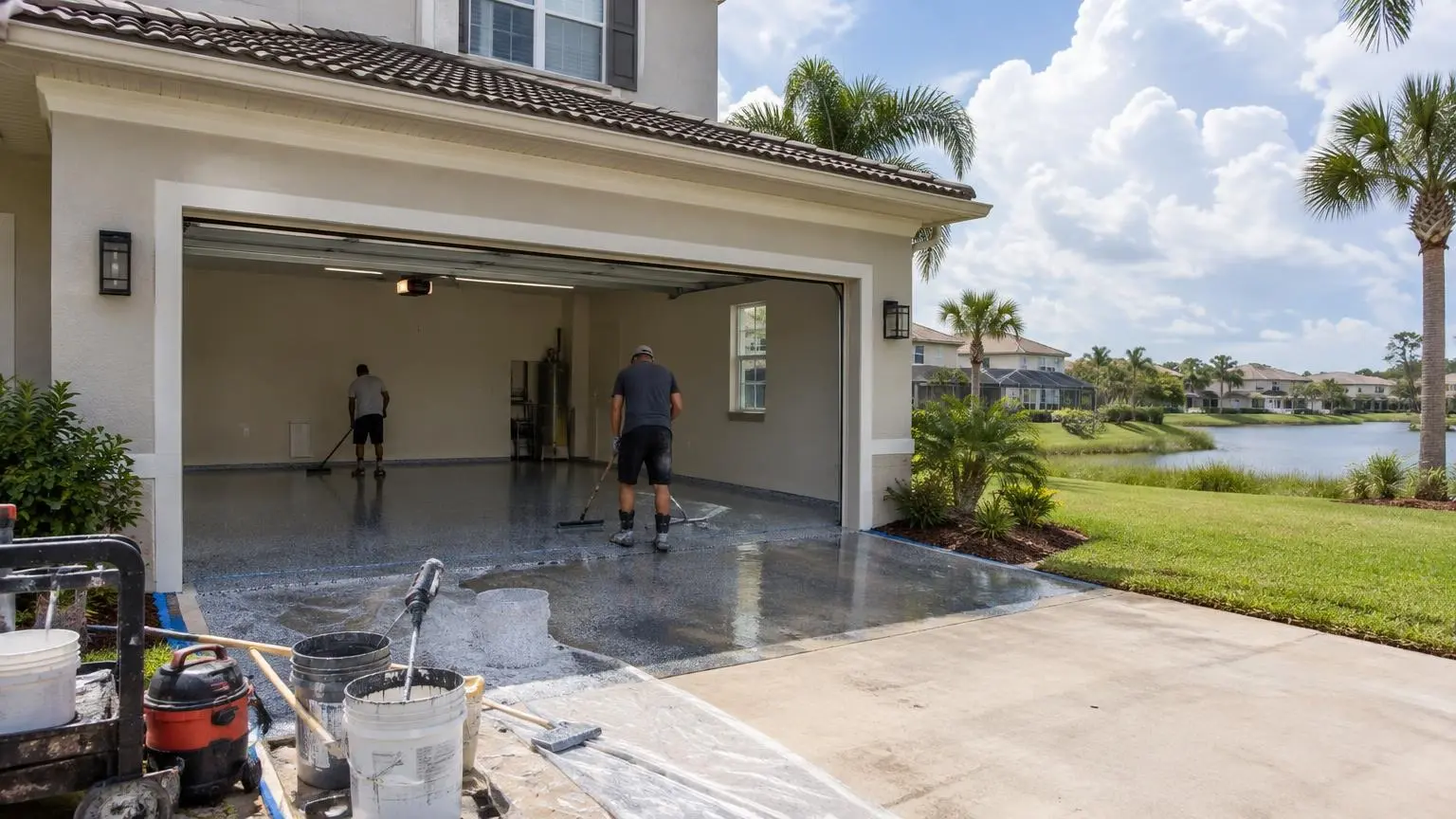
Garage floor coating for Central Florida homes
Epoxy Garage Floors in Orlando, FL
A tough, cleanable garage floor epoxy system, put down only after your slab passes a moisture check.
- Moisture reading taken at every free on-site visit
- A written quote that lists every coat and prep step
- Surface prep explained before any grinding begins
What a Coated Garage Floor Has to Survive Here
Epoxy garage floors in Orlando take a different beating than they do in colder places. There is no road salt and almost no frost, since the city averages only about 1.6 freezing nights a year. What a garage floor here does face is humid air for months at a time, rain-soaked ground under the slab, tires that roll in hot off sun-baked asphalt, and afternoon light pouring through an open door. A good epoxy garage floor is built around those four pressures, and the work begins long before the first coat.
Why bare garage concrete looks worn so fast
Concrete is porous. It drinks oil, transmission fluid, pool chemicals and fertilizer, and it sheds a fine dust that gets tracked inside. In a wet summer it can also sweat, leaving damp patches and a musty smell. A sealed garage floor coating closes those pores. Spills sit on top where a paper towel can lift them, and dust stops coming up from the slab itself. Many Orlando owners also use the garage as a gym, a workshop, a laundry area or overflow storage, and a coated floor makes that space far easier to keep clean.
Moisture is the first test, not the last
Wikipedia's climate summary for Orlando records 51.45 inches of yearly rainfall on average, and the region's low, flat ground sits among hundreds of lakes. Water in the soil moves upward through a slab as vapor. If a coating seals the top of a slab that is pushing vapor, pressure builds and the film can bubble or peel. That is why we test every garage before we quote it. A normal reading gets a standard primer. A high reading gets a moisture-tolerant epoxy primer made for that job, priced openly on the quote.
Grinding is what makes it stick
Garage slabs in newer subdivisions are often troweled very smooth, and older ones carry sealers, paint or years of oil. Neither will hold a coating. We diamond grind the entire floor to open the surface, then vacuum it clean. Cracks and spalled control joints are filled and ground flush, and oil stains are degreased or ground out. Skipping this work is the main reason store-bought kits fail, often within a year or two.
Picking the right system for your garage
Not every garage needs the same build. A typical coated garage here uses a 100% solids epoxy base for thickness and bonding, an optional decorative flake broadcast, and a polyaspartic topcoat for UV stability and scratch resistance. On HomeGuide's UV scale, polyaspartic scores excellent and epoxy just poor to fair, which matters for any garage whose door faces west or south. If you want a plain solid color, we can do that too, but we still recommend a UV-stable clear on top if sunlight reaches the floor.
How long you will be out of the garage
Epoxy needs time. Per HomeGuide, polyaspartic carries heavy vehicles after roughly 24 to 48 hours, and epoxy can want close to seven days to cure fully. Crew time on a garage runs from a single day up to about three, and the cure clock starts after that. In the wet season we may also have to space coats around humidity, so we give you a timeline at the estimate and keep you posted if weather moves it.
Living with the floor
A well-built garage floor epoxy system needs very little care. Sweep or blow out grit, damp-mop with gentle soap, and blot chemical spills quickly. Hot tire pickup is rarely a problem with a full-thickness system, and if a heavy dropped tool chips a spot, it can usually be patched without redoing the whole floor.
Golf carts, boats and benches
Plenty of Orlando garages hold a golf cart, a boat on a trailer, a second fridge, pool supplies or a home workshop. Each of those changes the floor we suggest. Golf cart and trailer tires concentrate weight in small spots, so a thicker base helps. Pool chemicals and fertilizer bags can stain bare concrete, so a sealed, chemical-resistant topcoat is worth it near the storage shelves. Workshops collect metal shavings, sawdust and dropped tools, and a flake floor hides wear while a light color makes the room brighter to work in. Tell us what lives in your garage and we will build the floor around it.
Questions worth asking before you sign
Before you hire anyone to coat a garage, ask how they prepare the slab, whether they test for moisture, what the topcoat is, how thick the finished system will be, and how long before you can drive on it. You should get all of that in writing. Our quotes list each of those items which makes checking bids side by side simple.
Storm prep and the garage
During hurricane season, garages fill with plywood, generators, gas cans and water jugs. A sealed floor makes it easier to clean up fuel drips and wet debris afterward, and a floor that has been ground and coated will not soak up spilled gasoline the way bare concrete does.
Garage Floor Options We Install
Every garage gets the same prep. What goes on top depends on your use, your light and your budget.
Solid-color epoxy with clear topcoat
A clean, single-color look in gray, tan or white, sealed with a UV-stable clear to keep the color from shifting.
Flake broadcast garage floor
Colored vinyl chips thrown into wet resin, giving texture and a pattern that disguises grit. See our flake page for blends.
Full polyaspartic garage floor
A faster system for owners who cannot spare the garage for long. See our one-day polyaspartic page.
Moisture-tolerant primer
A primer made for slabs that read high on our moisture test, used before any base coat.
Crack and joint repair
Hairline cracks, pitting and chipped saw-cut joints are packed with repair material and ground level before any color goes on.
Anti-slip additive
Fine grit mixed into the final coat so the floor has grip when wet shoes or a dripping car come in.
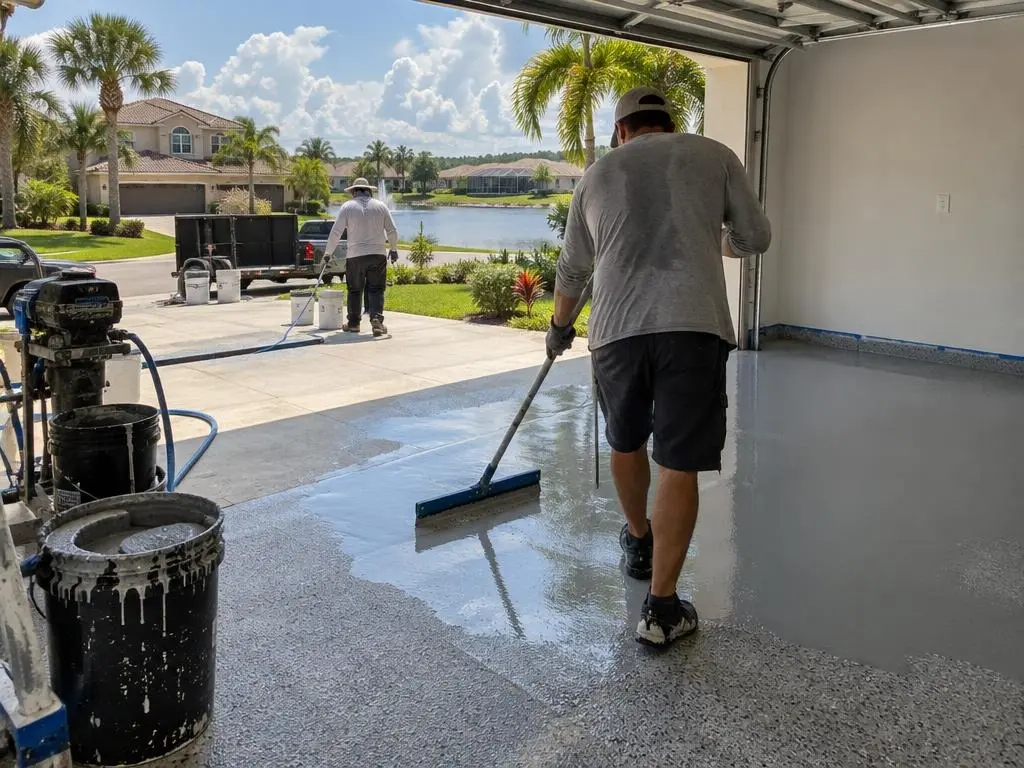
What Garage Coatings Run Nationally
| Garage size or add-on | Range, with the guide it comes from |
|---|---|
| Installed epoxy, per square foot | $4 to $10 (HomeGuide) |
| One-car garage, epoxy | $1,200 to $3,900 (HomeGuide) |
| Two-car garage, epoxy | $1,600 to $5,800 (HomeGuide) |
| Three-car garage, epoxy | $2,300 to $8,600 (HomeGuide) |
| Polyurea coating, per square foot | $5 to $10 (HomeGuide garage coating guide) |
| Crack and chip patching | $25 to $250 (This Old House) |
These are national figures, not an Orlando price list. The size of your garage, old coatings, repairs and your finish choice shift the total. We put your exact price on a written estimate after we see the slab.
From Bare Slab to Parking Again
1. Look and test
We measure the garage, note oil, paint and cracks, and check how much moisture the slab is giving off.
2. Written quote
You get the system, every coat, the prep method, cure times and the total in writing.
3. Grind and repair
Diamond tooling opens the floor, fill cracks and joints, and vacuum the dust away.
4. Prime and build
Primer goes on, then the base coat, with flake broadcast if you chose it.
5. Seal the top
A UV-stable topcoat finishes the floor, with grit added if you want more traction.
6. Cure and hand back
Expect a note with the walk-on hour, the drive-on day and a cleaning routine.
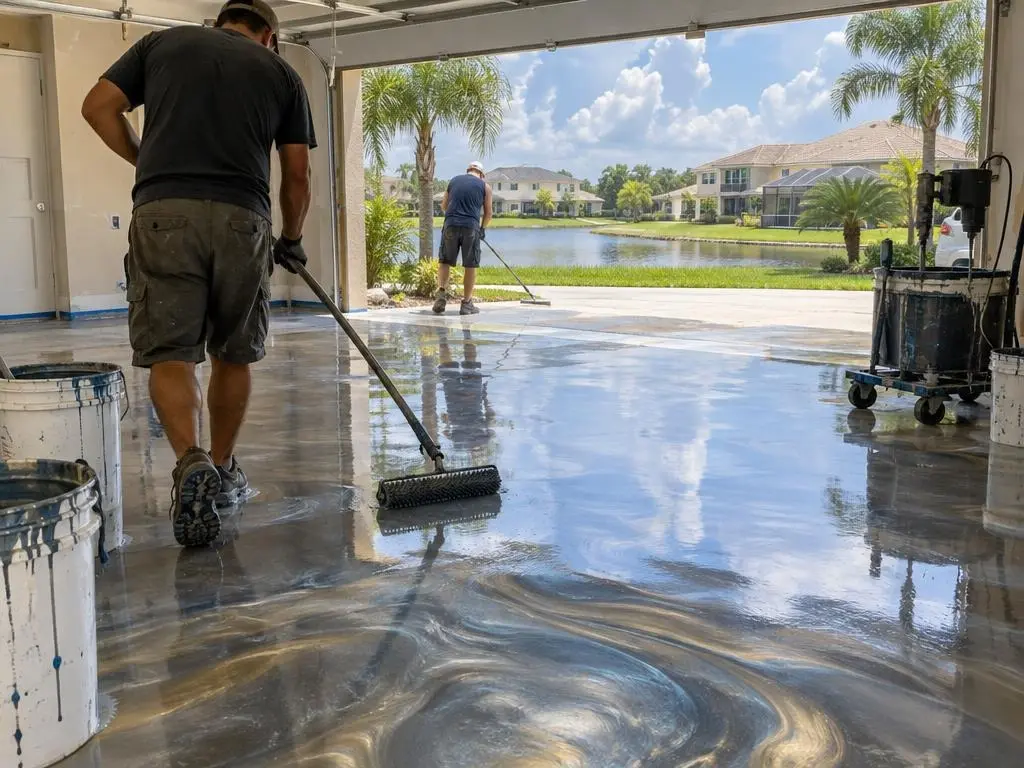
Why Choose Us for Epoxy Garage Floors
No coating on a damp slab
If the moisture reading is high, we address it with the right primer or advise waiting until the slab dries.
Topcoats picked for the sun
West- and south-facing garages get UV-stable clears so the floor keeps its color.
Clear cure times
You know before we start how many days the garage is off limits.
Epoxy Garage Floors Questions
Will an epoxy garage floor peel from hot tires?
Tires lifting a coating is mostly a problem of thin paints and kits applied over poorly prepared concrete. A ground slab with a full-thickness base and a polyaspartic topcoat holds up to Florida summer tires.
Can you coat over the paint already on my garage floor?
No. Old paint and sealers get ground away until the resin can lock onto bare concrete. Coating over old paint ties the new floor to whatever is holding the old one, which is usually not much.
Will a coated garage get slick on rainy days?
High gloss turns slippery once water is on it. Chips give the surface some tooth, and grit stirred into the clear adds more.
Does everything have to come out of the garage?
Yes. The whole floor has to be ground and coated, so cars, shelving and stored items need to come out before we start and stay out until the floor has cured.
What lifespan does a garage floor coating have?
HomeGuide puts solid epoxy at 10 to 20 years and water-based kits at 3 to 5. Prep, thickness, sun exposure and how hard the garage is used decide where yours falls.
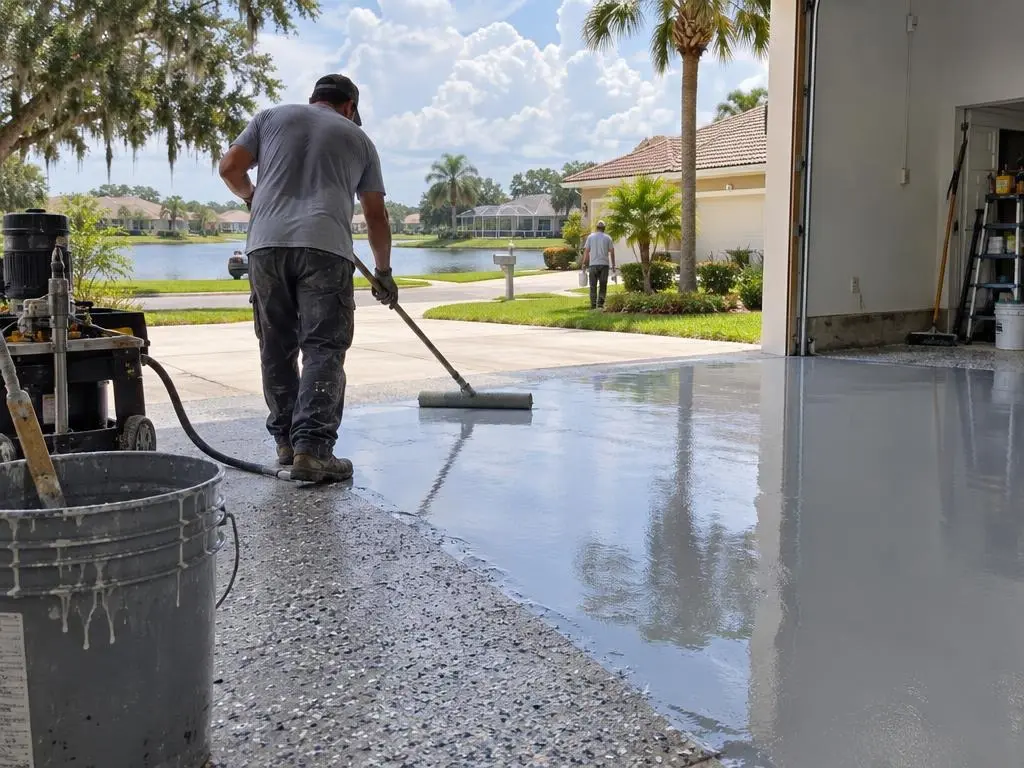
Epoxy Garage Floors Service Areas
- Epoxy Flooring in Orlando, FL
- Epoxy Flooring in Winter Park, FL
- Epoxy Flooring in Maitland, FL
- Epoxy Flooring in Winter Garden, FL
- Epoxy Flooring in Windermere, FL
- Epoxy Flooring in Ocoee, FL
- Epoxy Flooring in Apopka, FL
- Epoxy Flooring in Altamonte Springs, FL
- Epoxy Flooring in Casselberry, FL
- Epoxy Flooring in Oviedo, FL
- Epoxy Flooring in Winter Springs, FL
- Epoxy Flooring in Sanford, FL
- Epoxy Flooring in Lake Mary, FL
- Epoxy Flooring in Longwood, FL
- Epoxy Flooring in Kissimmee, FL
- Epoxy Flooring in St. Cloud, FL
- Epoxy Flooring in Clermont, FL
- Epoxy Flooring in Lake Nona, FL
- Epoxy Flooring in Doctor Phillips, FL
- Epoxy Flooring in Celebration, FL
- Epoxy Flooring in Belle Isle, FL
- Epoxy Flooring in Conway, FL
- Epoxy Flooring in Horizon West, FL
- Epoxy Flooring in Meadow Woods, FL
- Epoxy Flooring in Hunters Creek, FL
Get an Epoxy Garage Floors Estimate
Book a free look at your garage. We test the slab and give you the price in writing.